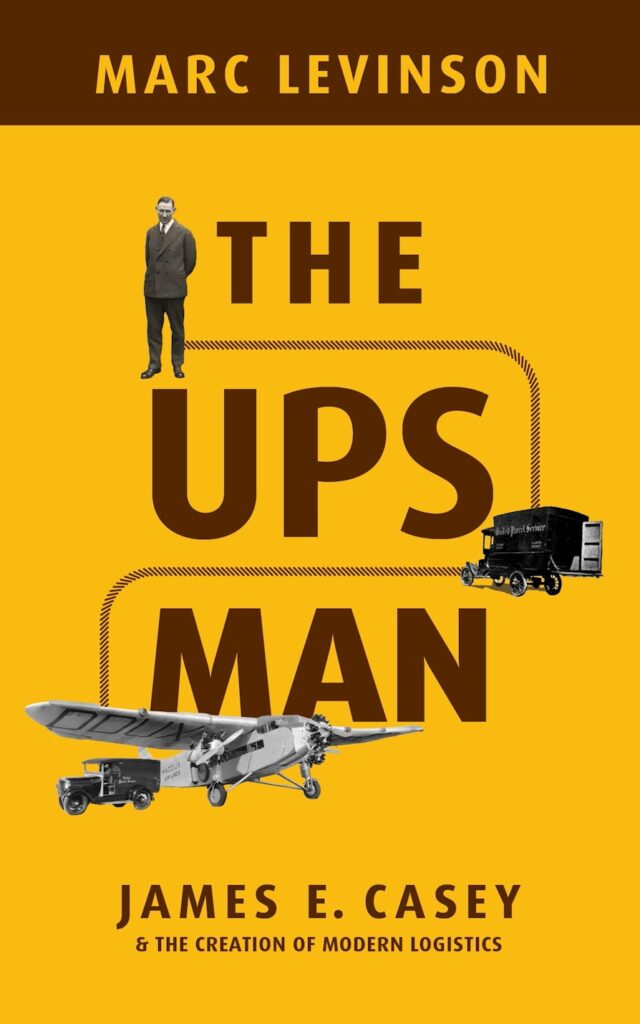
To the public at large, James E. Casey is an all-but-unknown figure. Those who study business may know his name, but not much else. Those associated with United Parcel Service, the company he cofounded back in 1907 will have heard his merits praised frequently, but much of what they learn of him is incomplete or incorrect. Unlike many business leaders, Jim Casey had absolutely no ambition to be a master of the universe. Shy and even withdrawn, soft-spoken and often hesitant to advance an opinion, he was content to stay out of the spotlight, making sure the job got done and that others shared the credit.
So why, one might justifiably ask, would anyone wish to read about him? The answer is that he laid the foundation of an industry that is central to our modern world. Born in 1888, Casey spent his life, starting at the tender age of eleven, thinking about how to deliver things more efficiently. A self-taught executive whose education ended with the seventh grade, he expanded a tiny messenger service into United Parcel Service, a giant of modern logistics. He lived and breathed packages for nearly the entire twentieth century, introducing innovation after innovation into the stodgiest of industries as he patiently built the first company able to collect packages from hundreds of thousands of senders, plot their movement, and deliver them on specified dates, and often at specified times, to recipients far away. Parcel delivery, as it developed thanks to his vision, prepared the way for the logistical systems that allow supply chains to span the world and enable consumers to obtain almost anything from almost anywhere with a credit card and a couple days’ patience.
But while Casey was an inspiring leader, he was also a ferocious competitor. Under his leadership, UPS frequently acted in ways that it prefers not to include in its corporate mythology. Some of these actions were dubious. Others were flat-out illegal. Certain of them might not make current employees proud, yet were indispensable in UPS’s transformation into a global transportation powerhouse. These are as much a part of Casey’s legacy as the company’s successes,
Until now, Casey has never been the subject of a biography. He had no descendants and is not known to have left the sorts of personal papers on which biographers typically rely. Whatever material resides in the UPS archives is not accessible to outsiders. Based on previously ignored sources, The UPS Man paints a portrait of a secretive man who had an obsessive fascination with parcels, an openness to new ideas—and, at times, a willingness to bend the rules and override his own stated principles in order for his company to succeed. That more than 300,000 packages are delivered somewhere in the world every minute of every day is a monument to his accomplishments.
The UPS Man was longlisted for the Financial Times/Standard Chartered Business Book of the Year Award in August 2026. It will be published on October 27.