
Tag: Shipping

  • Who’ll Pay for Maritime Dominance?

    The Trump Administration’s Maritime Action Plan, released on February 13, proposes to channel potentially enormous amounts of money into the flaccid U.S. shipbuilding industry. While the plan is far from becoming law, some of the Administration’s proposals could weigh heavily on U.S. foreign trade by imposing new fees on imports and requiring that some containerized cargo travel on U.S.-flag ships.

    The plan would establish a Maritime Security Trust Fund, funded by a fee based on the weight of the cargo aboard foreign-built vessels arriving at U.S. ports. It does not say how much money would be needed to support a serious commercial shipbuilding program. Here’s a back-of-the envelope calculation: based on recent import volume, matching China’s estimated shipbuilding subsidies of $15 billion a year would require a fee of $25 per metric ton. This would add around $500 to the cost of importing an average 40-foot container. Such a fee would raise the cost of shipping a container across the Pacific by about one-quarter, across the North Atlantic by one-third.

    Note that a fee of this size probably wouldn’t do much for commercial shipbuilding if military shipyards share the pie, a point on which the Trump plan is unclear. In any case, such a fee would not raise enough revenue to compensate shipbuilders for the exorbitant cost of having to use U.S.-made steel, which costs more than twice as much as Chinese-made steel due to U.S. tariffs.

    Who will buy the commercial ships U.S. shipyards are expected to turn out? The Maritime Action Plan foresees that “U.S.-built ships should eventually ferry the nation’s international trade.” Until then, the plan would “require high-volume exporting economies to transport a gradually increasing percentage of their U.S.-bound containerized cargo on qualifying U.S. vessels,” including foreign-built vessels that could be registered under the U.S. flag. Given that hundreds of thousands of U.S. importers and foreign exporters make shipping arrangements on a case-by-case basis, it’s hard to imagine how governments would determine which ships they must use.

    However, it’s not hard to imagine that the policies outlined in the Maritime Action Plan could make it more expensive to bring imports to the United States.

  • Misguided Missiles

    I’ve received several inquiries from journalists asking my thoughts about how the attacks on commercial ships off the coast of Yemen are likely to affect trade and shipping. There’s no question that the unfriendly fire of the Houthis and their Iranian sponsors since November 19, when black-clad fighters carrying automatic weapons dropped from a helicopter onto the deck of a car-carrying vessel in the Red Sea, is outrageous. But for the world economy, the disruption of shipping as carriers avoid the Red Sea and the Suez Canal is an inconvenience, not a catastrophe.

    Some people seem to associate the current goings-on with the supply-chain chaos during the COVID-19 pandemic. Then, port closures, crew shortages, and delays moving cargo into and out of container terminals led to hundreds of sailings being cancelled at a time when demand for manufactured goods was unexpectedly strong. At one point, more than 500 container ships were queuing outside harbors on three continents to load or discharge. Freight rates reached the stratosphere. Manufacturers and retailers had no idea where their goods were or when they might be delivered.

    Conditions today are quite different. Before November 19, the cost of shipping a 40-foot box had tumbled to the lowest level in four years and a record level of shipbuilding portended excess capacity well into the future. The Houthis’ attacks have led many carriers to sail around Africa, lengthening the trip between Shanghai and Rotterdam by eight days to three weeks, depending on how fast the carrier wants to steam. The longer voyage times have sopped up excess capacity, restoring the pricing power container carriers lost with the end of the pandemic. They must pay more for fuel, wages, and mortgage or lease payments on each trip, but save by avoiding Suez Canal tolls. Higher ocean freight costs will likely be reflected modestly in consumer prices, but they are not likely to turbocharge inflation.

    Although ocean transport is taking longer than it did before the Houthis took aim at merchant shipping, the impact of those delays is related mainly to private companies’ decisions about how to structure their supply chains. That’s why I find it troubling that the United States and several other countries claim to be attacking Houthi fighters and weapons systems “to defend lives and the free flow of commerce.” When we read that shipping delays have led to retailers lacking goods to sell and an auto assembly line closing for want of parts, we should remember that companies, not governments, determine where to obtain inputs and how much inventory to hold in the warehouse. Some companies work harder than others to make their supply chains resilient. Protecting those that have chosen to accept greater risk of supply-chain disruption is not a good reason to shoot missiles at Yemen.

  • Sustainability and Trade

    The cost of mitigating climate change is hard to put a finger on. That’s one conclusion from a recent conference on climate change and macroeconomics at the Peterson Institute for International Economics in Washington. Many of the economists who spoke argued that there is no conflict between sustainability and prosperity; in their view, keeping global temperatures at 1.5 degrees Celsius above pre-industrial levels, as urged by the Intergovernmental Panel on Climate Change, will require minimal economic sacrifice, at least in most countries. Others forecast that higher temperatures and more frequent severe weather events will make output and prices more volatile, or that the cost of renewable energy will retard economic growth. At this point, you can pick whichever conclusion you prefer.

    What I found most notable about this meeting was that international trade wasn’t on the table. To me, it seems likely that concerns about climate change will depress trade. Measures like the European Union’s Carbon Border Adjustment Mechanism and proposed U.S. legislation requiring studies of the emissions intensity of many imports will erode some of the cost advantage of foreign products. In addition, shipping powered by sustainable fuels may be far more expensive than shipping is today. For trade in liquor and tablet computers, higher freight costs may not matter, but shipping low-value goods long distances — the United States exported 4 million metric tons of hay last year — may become prohibitively costly.

    The importance of international trade in stimulating innovation, increasing competition, and making economies more dynamic is no secret. If measures to control climate change prove to be a drag on trade, they are likely to be a macroeconomic drag as well. That’s a possibility economists concerned with sustainability should not ignore.

  • The Cost of Slow

    A few days ago, I chatted with a shipping executive who made a bold prediction. The future of ocean shipping, he told me, is slow: the maritime industry faces great pressure to reduce its greenhouse gas emissions, he said, and steaming at lower speeds is the only way to do it. If my friend is right, he has identified an additional drag that will depress the growth of goods trade in the years ahead.

    After ocean carriers first tried out “slow steaming” around 2007, container ships required three or four additional days to cross the Pacific and as much as an extra week to steam between Asia and Northern Europe — long before pandemic-induced backups at major ports. Steaming slower still will make it even less attractive to send goods pegged to fashions and fads long distances by water. Manufacturers and retailers may choose instead to relocate time-sensitive parts of their supply chains closer to their customers, even if that means higher factory production costs.

    Slower steaming will influence globalization in less visible ways as well. As container ships travel more slowly, each ship will complete fewer round trips each year. That will effectively reduce the shipping industry’s capacity. At the same time, each voyage will entail more days of crew wages and mortgage payments than a similar trip today. This combination of factors means container freight rates are likely to remain higher than they might otherwise be. Containers themselves will have to be leased for a longer period in order to complete a shipment across the oceans, adding to the freight bill.

    And then there is the matter of inventory costs. In recent years, with interest rates near zero, the shippers who own the goods aboard those vessels queuing for a berth at major ports haven’t faced much of a financial penalty due to longer transit times. But interest rates aren’t zero any more, and the cost of owning goods during longer trips across the seas is no longer negligible.

    As I wrote in Outside the Box, trade in manufactured goods is likely to grow more slowly than the world economy in the years ahead. While container shipping rates seem to be descending from their pandemic peaks, slower steaming means that the days when transport costs were an afterthought may not return soon. Companies will have to take this into account as they decide what to make where.

  • General Average

    In the modern world of global commerce, it isn’t easy being small. Yes, if you go on the internet to book passage for a container of your precious cargo, the ship line will accommodate you. But you may be sorry. You’ll have to pay the carrier’s published rate for your box, which will undoubtedly be far higher than the rates negotiated by the large manufacturers, retailers, and freight forwarders that ship hundreds of containers each week. You’ll be subject to all sorts of indignities from customs authorities and security officials who are suspicious of unfamiliar shippers, likely delaying your goods. And, in case you haven’t heard, you may be on the hook if something goes wrong with the ship that is carrying your cargo.

    In the eight days since Evergreen Marine’s ship Ever Given was freed from the muck of the Suez Canal and sent north to the Great Bitter Lake for inspection, it’s become clear that small shippers are likely to be among the biggest losers from its ignominious grounding. The reason is something called the General Average, a practice that requires a shipowner and the shippers whose cargo is aboard to share the costs of saving the vessel after a major casualty.

    In this case, the shipowner, the Japanese company Shoei Kisen, has declared a General Average and has engaged a London-based insurance adjuster called Richards Hogg Lindley to figure out the value of each of the thousands of shipments on board. Once the cost of the casualty has been determined, each owner will be assessed a proportionate share of the costs, usually expressed as a percentage of the value of its cargo.

    Figuring out the cost of the casualty will take a while. In order to get the ship underway sooner, the cargo owners are expected to put up deposits to have their cargo released. For most big companies with goods aboard, that should be no problem: they’ll call their marine insurers, who will provide guarantees. But small shippers — think of a tiny umbrella manufacturer in south China, or a Belgian discount store with an order of cheap blouses on the way — may have skipped marine insurance to save money. To gain control of their cargo, they’ll need to put up cash deposits, but they may be hard pressed to raise the cash without controlling the cargo. If they fail to resolve this chicken-and-egg problem, the ship owner can hold and, eventually, sell the goods. Some of the shippers may lack the resources to withstand the loss.

    As maritime accidents go, the grounding of Ever Given will probably not be among the most costly. Even so, there are likely to be many parties that claim damages, including Egypt’s Suez Canal Authority and the owners of the hundreds of vessels that were delayed while the canal was closed. We can expect to see enough claims and counterclaims to keep lawyers busy for years. And I expect we’ll read the sad stories of small business owners with big dreams, who discovered that the global marketplace hides risks they’d never thought about, such as responsibility for an accident they did not cause.

  • Stuck in the Mud

    On the morning of March 23, a container ship called Ever Given ran aground in the Suez Canal, blocking passage to the 50 or more vessels that transit the canal each day between the Red Sea and the Mediterranean. This disruption to global supply chains is likely to prove extremely costly. The grounding is one more example of how the shipping industry’s insane quest for size and scale has made global value chains more fragile and less reliable.

    Ever Given was launched in March 2018. The ship, a quarter-mile long and nearly 200 feet across, is reportedly able to carry the equivalent of 20,388 20-foot containers — enough cargo to fill more than 10,000 over-the-road trucks. It was en route from China to Northern Europe, one of the few ocean routes on which such enormous vessels are practical. The number of containers on board at the time of the grounding has not been disclosed, but in recent months load factors on the Asia-Europe route have been high.

    What went wrong? At this point, much is speculation. But the vessel’s massive size was likely a factor, for at least two different reasons.

    The first is that ultra-large container ships need deep water: when the ship is fully loaded, the deepest part of Ever Given‘s keel lies 15.7 meters — nearby 52 feet — beneath the water line. If a ship of that size wanders out of the proper channel, it can quickly wander into trouble.

    The second factor that may have contributed to the grounding is the ship’s heavy load. The only way to fit 10,000 40-foot containers aboard a single ship is by stacking boxes high on its deck. Ever Given, photographs suggest, had containers stacked 10-high from stem to stern, in addition to the many boxes in its hold. Steaming north through the canal, it would have presented a solid 80-foot-high wall longer than four football fields to winds blowing from the west. If, as reported, a wind storm struck the canal that day, it is easy to imagine how the vessel could have been blown off course. Something similar happened to Ever Given before. In February 2019, less than a year after its launch, high winds pushed it up against a ferry in the Elbe River in Hamburg, with unfortunate consequences for the ferry.

    The price tag on the physical damage is likely to be far less than the cost of the economic disruption the grounding has caused. Hundreds of ships have been delayed, each potentially facing tens of thousands of dollars per day in crew wages and lease or mortgage payments while it rests at anchor. The bill facing cargo owners will be even higher, as they face the carrying costs on the tens of billions of dollars’ worth of cargo marooned aboard vessels now moored at either end of the Suez Canal.

    It’s not clear whether they will be able to recover these losses, or who might pay for them. Like many merchant ships, Ever Given has a complicated chain of control, with its Japanese owner having chartered it out to a Taiwanese ship line which engaged a German company to operate it. Future litigation promises to be interesting.

    The Ever Given incident is one more demonstration of the vulnerabilities of extended value chains, a subject I discuss in Outside the Box. An accident can happen to any ship, and the potential cost needs to be factored into decisions about where to make things and how to transport them.

  • After the Age of Stuff

    The last few decades, during which long value chains have reshaped the world economy, have been notable for one characteristic above all: a rapidly improving material standard of living.  In 1987, China’s streets were crowded with bicycles, and its auto plants turned out all of 17,840 new cars; thirty years later, China produced more motor vehicles by far than any other country. The price of clothing tumbled, which may explain why the average person in Great Britain purchased five times as many pieces of apparel in 2017 as three decades earlier. The median new home built in the United States in 2017 was 38 percent larger than in 1987, with 2,426 square feet to fill with acquisitions, and there was a one-in-three chance that it had more than one refrigerator. The intervening years could aptly be named the age of stuff.

    Those days are not entirely over, but data from many countries suggest that consumers increasingly are spending their money on services and experiences rather than goods. In part, that’s because goods prices are falling while services prices are not. But it also reflects real changes in purchasing patterns.

    There are several reasons “stuff” is losing ground. One is that the world is aging. From Iran to China to Mexico to Italy, median ages are moving steadily higher. Older households have had years to accumulate belongings and are often disinclined to acquire more; vacation trips, restaurant meals, and medical bills are likely to figure larger in their spending than furniture and fixtures.

    Another factor suppressing demand for physical products is the transformation of goods into services. Digital downloads and streaming services have made it possible to enjoy films, books, and music without physically possessing a television set, a book, or a stereo. Automakers assume that consumers will prefer to pay a car-sharing service for access to a vehicle when needed rather than purchasing a car for exclusive use—a development that seems likely to lead to a decline in the total number of registered vehicles. Instead of buying dresses, some women are renting them for a few days from an apparel lending service. Sharing reduces the waste of assets sitting idle—and thereby reduces the demand for those assets.

    Many industries will still involve making stuff, but the manufacturing process will likely become simpler, requiring less labor. Unlike vehicles powered by gasoline or diesel engines, electric vehicles do not have engines, transmissions, and emissions-control equipment, so as they gain market share, there will be less need for workers to produce gears and piston rings—and less reason to farm production out to low-wage countries. Automated factories are now making athletic shoes in the United States and Germany, taking jobs from factory workers in Indonesia. With additive manufacturing, in which a computer directs a printer to build an object by depositing layer upon layer of a plastic or metallic material at precise locations, manufacturers can make specialized parts in small quantities near where they are needed instead of shipping them from far away. By squeezing out labor costs, such technologies are eliminating a major rationale for far-flung value chains.

    All these developments were underway well before China announced its Made in China 2025 plan in 2015, the British voted to leave the European Union in 2016, and Donald Trump became the U.S. president in 2017. I think they’ll continue even if the United States and China retreat from the brink of a trade war. Globalization isn’t going away, but I expect that over the coming years it will have less and less to do with giant ships carrying boxes full of stuff around the world. For more on why I think globalization is changing, see my new book, Outside the Box.

  • Megamess

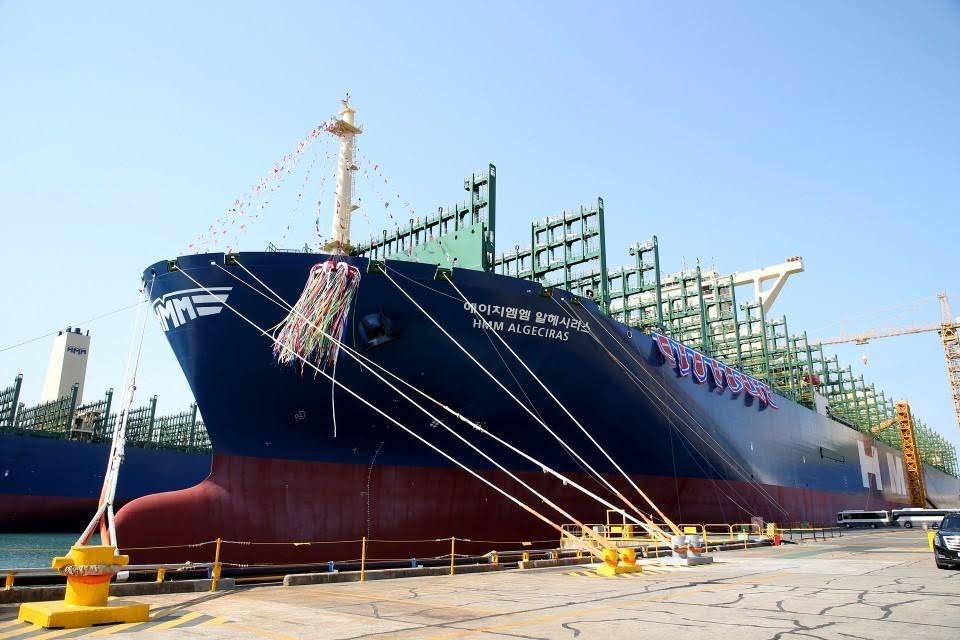
    The world economy, as you may have noticed, hasn’t been doing so well of late. Economic growth was slowing and international trade languishing even before COVID-19 swept across the globe. Now, we’re tumbling into a downturn that makes the global financial crisis of 2007-2009 look mild. So, of course, it’s the perfect time to introduce the largest containership ever built.

    Meet the HMM Algeciras, which was just launched by Daewoo Shipbuilding in South Korea. HMM is the new name of Hyundai Merchant Marine, the last big Korean container line left standing after the collapse of Hanjin Shipping in 2016. Hanjin’s bankruptcy and eventual dismemberment was a direct result of a market flooded with excess capacity due to carriers’ blind enthusiasm for very large ships. South Korea’s government made sure Hyundai Merchant Marine survived, and induced it to build 20 ships with extremely generous subsidies. Eleven more the size of HMM Algeciras are to be delivered later this year.

    These megaships, each capable of carrying as much cargo as 12,000 full-sized trucks, are being built not to meet the demands of exporters and importers, but rather to preserve jobs at South Korea’s shipyards, steel mills, and marine equipment manufacturers. South Korean President Moon Jae-in expressed the “hope that HMM continues to secure a competitive advantage as a Korean national flagship carrier.” Elected officials have to say such things, but the reality is that HMM will be hard-pressed to fill its new vessels with Korean and Chinese goods bound for Northern Europe. They might be the most efficient ships at sea when fully loaded. But it’s more likely they’ll lumber half-empty across the oceans, spouting red ink as they go.

    HMM Algeciras is just the latest example of megaship mania. Shipyards in China and Korea continue to turn out enormous vessels, even though the boom in container trade ended long ago. Once the COVID-19 pandemic has passed, globalization won’t go away, but it will have more to do with spreading ideas than with moving stuff in metal boxes. Many of the carriers unwise enough to own megaships are likely to need government help once more as they struggle to clean up a megamess.