Tag: Manufacturing

  • Steel Confusion

    On May 19, the U.S. Department of Justice announced the indictment of four Chinese manufacturers of steel shipping containers and six of their executives for violations of antitrust law. Between 2019 and 2024, the indictment alleges, the companies and their executives conspired to limit container production and fix prices. Their conspiracy, the government contends, “affected domestic competition for imported goods in the United States by fixing a component of global shipping costs—that is, the price of standard dry shipping containers—paid by United States importers.”

    On June 18, after the U.S. International Trade Commission determined that U.S. manufacturers of chassis, the steel frames on which trucks haul shipping containers, have been injured by cheap imports, the Department of Commerce imposed duties reaching 109 percent on chassis from Mexico and even more on chassis from Thailand and Vietnam. The new duties will increase the price of chassis, including those used to transport containers filled with imports.

    In other words, the Trump Administration is blaming Chinese companies for raising the cost of importing goods in shipping containers even as its own actions raise the cost of importing goods in shipping containers.

    If this leaves you scratching your head, remember that containers and the chassis on which they ride have one thing in common. Both are made largely of steel—a product that federal policy has made extraordinarily expensive in the United States.  

    The underlying problem is that U.S. steel mills, for the most part, are not cost-competitive with large mills abroad. Some of their disadvantage has to do with poor productivity: output per worker at U.S. steel mills has tumbled since 2018. In addition, foreign governments’ subsidies to steelmakers are often more generous than those in the United States, allowing foreign mills to export steel at prices that would otherwise be unprofitable.

    Rather than countering foreign subsidies with domestic subsidies that would weigh on the federal budget, Washington has chosen to support the steel industry by taxing its customers. It has done this since 1969 by forcing up domestic steel prices in a variety of ways. At present, tariffs add 50 percent to the cost of most imported steel products, with some imports facing much higher rates.

    Protection for steelmakers is punishment for industries that use steel. Thanks to import barriers, steel sells in the United States for nearly three times as much as in China and at least one-and-a-half times as much as in Brazil, South Korea, or Europe. That is one reason production of containers and chassis migrated out of the United States in the first place.

    Making containers cheaper and chassis more expensive probably won’t have much effect on import prices; each of the eight thousand pairs of shoes filling a standard forty-foot container will probably cost just a few cents more to transport. This policy confusion, though, should give pause to the increasingly loud advocates of industrial policy. There are valid national security reasons to preserve a domestic steel industry, or at least a North American one. But the way to fight the Chinese container cartel and artificially cheap imported chassis is to keep the domestic price of steel low rather than forcing it up. As long as the United States has the world’s most expensive steel, relying on imported containers and chassis to transport our foreign trade makes perfect sense.

  • The Government’s Tariff Bill

    U.S. tariffs supposedly generated a record $31 billion in revenue during the month of August. According to a breathless report from Fox News, “The US could collect as much tariff revenue in just four months to five months as it did over the entire previous year.” But while those numbers may prove accurate, they represent only one side of the federal government’s ledger. There’s hasn’t been much attention to the fact that with the tariffs Washington is effectively taxing itself.

    President Trump has set a tariff rate of 50% on steel, copper, and aluminum imports from most countries, excluding Great Britain. He has also imposed a 50% rate on the steel or aluminum content in 407 different products, from truck trailers to barbecue forks with wood handles. Those tariffs don’t just affect imports. By making foreign products more expensive, they make it easier for domestic producers to jack up prices; were that not the case, the tariffs would serve no purpose.

    And who buys that domestic metal? Much of it ends up in goods purchased by Uncle Sam (fighter planes, postal delivery trucks) or by state and local governments using federal as well as state money (girders for highway bridges, pipes for water systems). With the tariffs in effect, governments buy less with each dollar they spend on such things.

    Steep tariffs on pharmaceuticals are supposedly impending. The United States and the European Union have agreed that European drugs will face a 15% U.S. tariff, and Trump has threatened tariffs of up to 250% on drugs from other countries. Since the Washington pays 59% of the cost of outpatient prescription drugs and the states pay another 5% to 10%, governments will bear most of the burden of higher prices.

    These tariffs are not affected by the recent court decision blocking many of the tariffs Trump has proposed. They could remain in place indefinitely. And as long as they do, U.S. taxpayers will pay far more than they should for the goods their tax dollars buy.

  • Factory Job

    The Trump Administration is racing to discharge tens of thousands of federal workers in order to do away with government activities it dislikes. And what are those displaced workers to do? Treasury Secretary Scott Bessent offered an answer on April 7. “[W]e are shedding excess labor in the federal government,” he said, adding, “That will give us the labor that we need for the new manufacturing” which, he asserts, the Trump Administration’s higher tariffs will bring to the United States.

    This advice fits neatly with persistent claims that manufacturers can’t find workers. Last year, the head of the National Association of Manufacturers claimed that there were 800,000 unfilled manufacturing jobs. That number is likely to grow if the Administration succeeds in reducing the number of immigrants in the United States.

    This purported labor shortage is usually attributed to spoiled workers who avoid jobs that can be dirty and physically taxing. As one economist insists, “Young people, especially, are not interested in jobs in manufacturing.”

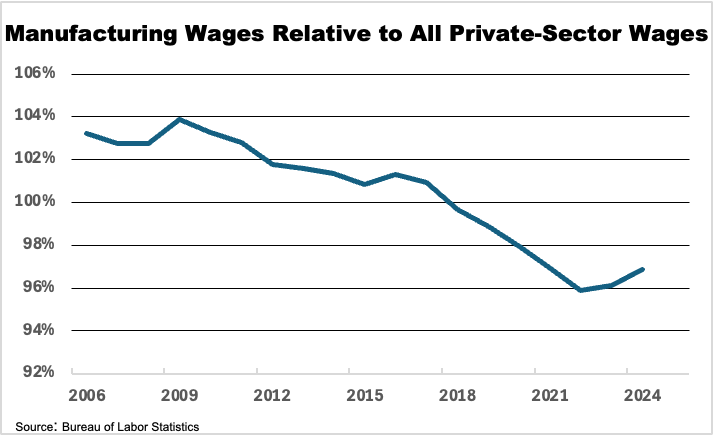
    Count me as skeptical. In general, I think, workers are good at sniffing out the best opportunities. The reason many shun manufacturing jobs is that, on average, they are no longer good jobs. Manufacturing workers used to earn a premium relative to workers in other industries. Due in part to foreign competition, that premium has vanished. Many of the fringe benefits that union factory workers used to enjoy have vanished as well.

    If theory, higher tariffs should help manufacturers earn greater profits from U.S. operations. But will higher profits mean better pay? It hasn’t worked out that way in the past: in primary metals, where steep tariffs protect the steel and aluminum industries, inflation-adjusted wages for production workers are five percent below their level in 2005. Does Mr. Bessent have a plan to ensure that any benefits of disrupting global supply chains are spread widely? If not, persuading displaced federal workers to staff newly built factories may be a hard sell.

  • Forgetting Friendshoring

    Remember friendshoring?

    Back in the days of COVID-19, when manufacturers and retailers suddenly paid attention to supply-chain risks they had previously ignored, the notion that they could reduce risk by “reshoring” manufacturing from abroad to U.S. locations came into vogue. The concept has some obvious limitations: it doesn’t eliminate the risks of relying on a single source of critical inputs or finished products, and costs make it impractical to produce many things domestically. “Nearshoring” was advanced as an alternative: perhaps some production could be moved from Asia to lower-wage U.S. neighbors. “Friendshoring” emerged during the Biden Administration — former Treasury Secretary Janet Yellen is often credited for coining the term — as another option, the idea being that national security risks could be controlled by sourcing sensitive goods from countries that are aligned with U.S. interests as well as from the United States.

    Since he took office on January 20, President Trump has taken or threatened unfriendly actions against some of those friends, including several countries — Panama, Colombia, Mexico, Canada — with which the United States has signed agreements to eliminate tariffs and other trade barriers. The announced tariffs on imports from China would also strike at many firms that draw on important inputs from China but are based in other friendly countries, such as Japan, South Korea, and Taiwan.

    The Trump Administration hasn’t had much to say about friendshoring, but its actions, whatever their other purposes, undermine the rationale for it. Companies that shift important links in their supply chains to “friendly” countries can no longer assume unfettered access to the U.S. market. That uncertainty may be enough to convince some firms to leave their Asia-based supply chains intact: If moving supplier locations doesn’t lower the firm’s costs or reduce the risk that trade barriers will interrupt its supply chains, why should it bother?

    The danger, of course, is that a decision that seems sensible for a firm may not be so sensible from a national security perspective. By being unfriendly toward friends, the United States may be increasing the very risks in critical supply chains that it has sought to minimize.

  • About That Manufacturing Renaissance

    The Biden Administration asserts there’s a “manufacturing renaissance” underway in the United States. Before it, the Trump administration claimed much the same. The federal government has certainly handed out a good deal of money to support manufacturing, in addition to aiding it with tariffs put in place by both Trump and Biden. But while manufacturing capacity, as measured by the Federal Reserve Board, has increased about 2.3 percent since Biden took office in 2021, labor productivity in manufacturing — basically, output per work hour — is down, according to figures released in early December. Total factor productivity, a measure of how industries improve technology and production processes to squeeze more output from a given quantity of inputs, fell in manufacturing in 2023 even as it rose in most other U.S. industries. These facts help explain why the Fed’s Industrial Production Index has been flat since the Obama years, save for a dip during the COVID-19 pandemic.

    How does this square with the boom in factory construction and the many newspaper articles about new factories reviving down-at-the-heels communities? What seems to be going on is less a manufacturing renaissance than a restructuring. According to the Census Bureau, the computer, electronic, and electrical manufacturing sector has accounted for well over half of manufacturers’ construction spending this year, and construction in the transportation equipment sector is also strong. Meanwhile, construction in other manufacturing sectors has barely grown or even declined after accounting for inflation.

    This is relevant to the much-discussed “reshoring” of manufacturing. To the extent that “reshoring” is underway, it seems to be concentrated in a handful of sectors, notably semiconductors, electric vehicle batteries, pharmaceuticals, and medical equipment. There are few signs of U.S.-made goods supplanting imports of industrial machinery, plastics and rubber products, synthetic fibers, paper, textiles, and any number of other products. Despite all the government support and the talk of tariffs, many manufacturers don’t seem to see the future in the United States.

  • Nearshoring in Mexico Is Mainly an Aspiration

    There’s been much talk about “nearshoring,” the idea that manufacturers are reducing risk in their supply chains by bringing production closer to their end markets. Mexico is supposedly one of the big winners from this trend, as companies by the score are said to be building factories there to serve the U.S. market. Much of this investment ostensibly comes from Chinese firms that want to make things in Mexico to circumvent U.S. tariffs and trade sanctions on imports from China.

    The data, though, show scant evidence of a Mexican manufacturing boom:

    • Industrial production in Mexico has risen only 7% over the past six years. Moreover, industrial growth has been dominated by petroleum refining, favored by the government and protected against foreign competition. Output in sectors such as paper, chemicals, and basic metals has flatlined, and manufacturing of transport equipment–the target of much foreign investment–has been growing by less than 1% per year. Traditional industries such as furniture and textiles have been shrinking.
    • Fixed investment is up sharply since a slump in 2020, but nonresidential construction and imported vehicles account for almost all the growth. Investment in machinery and equipment–the sorts of investment needed to open new factories–looks strong only because it looked so weak between 2018 and 2021.
    • Foreign direct investment set a record in the first quarter of this year, but almost all of that came from foreign companies reinvesting the profits of their Mexican operations. Very little new direct investment came into the country, and almost none of that money came from China.
    • The number of trucks crossing the border appears to be at a record level.

    What’s going on? One plausible explanation is that much of Mexico’s boom in nonresidential construction involves warehouses. The inventories of U.S. manufacturers and wholesalers are high, by historical standards. It’s often cheaper for them to import goods through the ports of Los Angeles and Long Beach and truck them to warehouses in Mexico than to store their stuff in the United States, so developers are building vast amounts of warehouse space in northern Mexico. The increase in cross-border truck traffic may be due to this merchandise moving back and forth rather than to exports of goods churned out by Mexican factories.

    Nearshoring, at least in Mexico, seems to be more of an aspiration than a reality, at least for now. Claudia Sheinbaum, who is to be sworn in as president on October 1, may need to make some major policy adjustments if she hopes to change that.

  • The FTC Seeks to Shelter Mom & Pop, Again

    In 1909, the Kellogg Toasted Corn Flake Company offered a “Square Deal.” Hoping to get its flakes on more grocers’ shelves, Kellogg set the cash price for wholesalers at 6.8 cents per box. Wholesalers were required to charge retailers 7.8 cents. Kellogg permitted no volume discounts, placing the neighborhood grocery store “on an equal footing with every other retailer, great or small.” Consumers paid 10 cents a box, a 47 percent markup over the factory-gate price, no matter where they purchased their corn flakes. This price-fixing pleased mom-and-pop grocers, but shoppers didn’t buy it: as bargain-hunters sought out cheaper cereals, Kellogg quietly cut prices for its largest customers, and the Square Deal faded away.

    This history is worth keeping in mind as the Federal Trade Commission tries to revive the Robinson-Patman Act, an 83-year-old law against price discrimination. According to press reports, the commission is investigating whether soft drink bottlers and an alcohol distributor violated that law by selling to big retailers on better terms than small ones. On March 27, Lina Kahn, the FTC’s chair, said the commission will move to enforce Robinson-Patman “in short order,” and her fellow commissioners have also called for reviving enforcement of the law. If the FTC does so, it will wade into a dispute that has pitted advocates of efficiency and low prices against supporters of small, independent businesses for well over a century.

    As chain food stores first emerged in the early 1900s, complaints spread that suppliers unfairly favored chains with discounts and inducements not available to smaller wholesalers and retailers. “The general working rules should be, ‘A fair price and the same to everybody,’” an official of the National Association of Retail Grocers demanded in 1914. Just as federal regulations kept railroads from favoring one shipper over another, the reasoning went, the law should require manufacturers and growers to charge all buyers the same price for the identical product. The Clayton Antitrust Act, passed that same year, gave small businesses half a loaf, prohibiting price discrimination when the effect “may be to substantially lessen competition or tend to create a monopoly.”

    And what of consumers? The leading consumer advocate of the day, Louis Brandeis, insisted they would barely be affected by a crack-down on price competition. He envisioned a marketplace where a consumer would not be confused by the possibility that “at some other store he could get that same article for less money.” In 1916, President Woodrow Wilson, an unabashed critic of price discrimination, named the Boston attorney to the Supreme Court.

    Shoppers plainly rejected Brandeis’s view, flocking to chain merchants. The most powerful was the Great Atlantic & Pacific Tea Company. A&P had 4,588 stores when it became the largest retailer in the world in 1920. By 1929, it owned nearly 16,000, along with a produce wholesaler, fish canneries and even a macaroni plant. It flourished because it underpriced competitors. To hold costs down, it demanded that suppliers offer volume discounts, give it rebates for advertising their goods and sell to it directly without paying commissions to wholesalers.

    Wholesalers and independent grocers complained bitterly. They were supported by small-town politicians and business groups, who feared that economic opportunity would be suppressed by “foreign” companies based in New York or Chicago. Chain store employees, advertisements in Springfield, Missouri proclaimed, were “‘mechanical operators’ controlled entirely by a set formula.” From Washington, the U.S. Chamber of Commerce warned that “the death knell has been sounded” for hundreds of thousands of small retailers.

    With early radio talk-show hosts fueling the uproar, governments raced to aid mom and pop. By 1933, 17 states hit chain stores with punishing taxes. State “fair trade” laws regulated mark-ups and required chains to maintain identical prices in every store. Officials in Kansas attacked A&P for charging more for coffee in Kansas City than in Topeka. A&P could sell five boxes of Waldorf tissue for 19 cents in Indiana, but across the state line in Ohio, that price was illegally low.

    The federal government joined in. To stem the spiral of wage and price cuts amid the Great Depression, Congress enacted the National Industrial Recovery Act of 1933, which authorized private industries to adopt binding codes of conduct. The code for the grocery trade mandated a specified percentage mark-up on each item, putting an end to loss leaders and two-for-one sales. This was intended to protect the small shops that provided livelihoods for hundreds of thousand of families, and it worked: with price discounting prohibited, chains rapidly lost market share.

    In May 1935, the codes were overturned by a unanimous Supreme Court, freeing chain retailers to demand better deals from suppliers and pass the savings on to customers. Within days, H. B. Teegarden, the general counsel of the Wholesale Grocers Association, drafted legislation to limit the impact of the court’s ruling by making it illegal, in most circumstances, for manufacturers to offer volume discounts. The bill barred lower prices for direct purchasers such as A&P than for retailers that purchased through wholesalers. A manufacturer paying a giant customer for advertising its product had to offer a proportionate allowance to the tiniest business.

    Manufacturers generally opposed this legislation: it cost them far less to sell by the boxcar than by the case, and they worried that higher prices might drive more retailers into manufacturing. Nonetheless, Congress enacted Teegarden’s bill as the Robinson-Patman Act in 1936. President Franklin Roosevelt apparently approved it reluctantly, for there are no known photographs of him signing it.

    The two main antitrust agencies responded in very different ways. The Department of Justice, which handles most industrial competition matters, generally ignored Robinson-Patman, while the FTC, which oversees competition in retailing, enforced the law aggressively. In 1938, it required A&P to pay for brokerage commissions on purchases involving no brokers. A decade later, it restrained the Morton Salt Company from selling small quantities of table salt at $1.60 per case while charging less to customers buying by the rail carload. These sorts of orders, repeatedly upheld by the courts, forced chain stores to raise prices. The discount revolution would be postponed by several decades, to help keep small businesses alive.

    By the 1960s, though, competition was driving manufacturers and retailers to find ways to work around Robinson-Patman. Can’t offer a volume discount to a big retailer? No problem: tinker with the product, so a giant chain can order a customized version, perhaps with a unique brand name, at a lower price. Want to grant a big buyer a discount for purchasing directly, without going through a wholesaler? Permit a discount for small customers, too—if they can master the technical demands for ordering, paying and taking delivery on the same terms as their larger competitors. With such circumventions, discount chains gained market share as Robinson-Patman fell into disuse.

    Global supply chains have made Robinson-Patman even less relevant. Large retailers and manufacturers commonly deal directly with foreign suppliers. Whether they are selling fuel injectors, frozen fish fillets or jars of artichoke hearts, those suppliers have no obligation to offer their goods at the same price to all U.S. customers. Despite all the talk about “reshoring” manufacturing, if the FTC tightens enforcement of Robinson-Patman, you can expect to find even more imported merchandise at the store, because shoppers’ interest in saving money is unlikely to go away.  

  • Nearshoring Is Hard to See

    Last week I was in Mexico City to speak at the Logistics World Summit, an annual event that draws thousands of truckers, freight forwarders, manufacturers, and software vendors to the soon-to-be-renamed Citibanamex Center. The topic on everyone’s mind was “nearshoring,” the much-touted shift of manufacturing from Asia to Mexico so as to reduce supply-chain risk. Real estate experts insist there’s a mass movement underway as foreign manufacturers seek factory sites convenient to the U.S. border. Trade and transportation data, however, paint a different picture. If nearshoring is underway, it is not yet visible in the numbers.

    In my talk, I pointed out that increased concern about supply-chain interruptions plays to Mexico’s advantage as a location for manufacturers targeting the North American market. But for all the talk of nearshoring, manufacturers seem reluctant to plunge in. This hesitation, I think, has to do with some real-world problems that have grown worse in recent years. Concerns about security are mounting all over the country. Electricity prices are high, despite government subsidies. Renewable energy is in short supply, deterring investment in factories to serve companies that face pressure from customers or regulators to reduce greenhouse-gas emissions in their supply chains.

    Moreover, Mexico seems unprepared for things to come. Factories in Mexico have increasingly used inputs from China to assemble goods for the U.S. market; given geopolitical tensions, it’s a good bet that Washington will crack down on imports of such products. And in the automotive sector, where Mexico’s role in international supply chains is most prominent, exports of auto parts are under threat as electric vehicles capture a larger share of the vehicle market in the United States and Canada. Recent announcements of a new Tesla assembly plant near Monterrey and a BMW battery plant in San Luis Potosí have obscured the fact that an electric vehicle contains thousands fewer parts than an internal combustion vehicle of similar size. The supply chains that funnel Mexican-made pistons, fuel injectors, catalytic converters, and other parts to points north are likely to decline rapidly over the next few years.

    Geography offers Mexico great opportunities as manufacturers and retailers rethink their supply chains. So far, though, it isn’t taking much advantage of them. Unless the Mexican government makes some big changes, nearshoring may be slow to develop.

  • Carbon Border Adjustments and Trade

    The European Union is on the way to taxing many imports based on their greenhouse-gas emissions. The plan, which was agreed by the European Commission and the European Parliament on December 13 but is not yet final, is one more factor likely to constrain the growth of international trade.

    The plan would establish an import taxation system called the Carbon Border Adjustment Mechanism, designed to force importers of certain products to pay for the carbon emitted in making their products. The tax would equal the amount an EU manufacturer would have paid to purchase permits for those emissions under the EU Emissions Trading System. The point is to stop the “leakage” that occurs when companies import products that would be subject to carbon charges if produced in the EU. Initially, imports of iron, steel, cement, aluminum, fertilizers, hydrogen, electricity, and products made from iron or steel will be subject to the tax, and some chemicals and polymers may be taxed as well. Imports from countries that tax carbon emissions as the EU does would not be taxed.

    Implementing this well-intended policy is likely to prove more complicated than EU officials are letting on. While calculating the tax on a bag of imported cement may be straightforward, accurately figuring the charge on a product containing steel from multiple mills drawing on multiple power sources may not be so easy.

    It’s possible that the new taxes will be ineffectual; if, for example, an Asian manufacturer simply ships fertilizer from an older plant to Africa while selling output from newer plants with lower carbon emissions to the EU, the tax might have no net effect on emissions. On the other hand, if the EU succeeds in convincing its trading partners to impose their own taxes on carbon emissions or if proceeds to require significant carbon border adjustments instead, some goods could become more expensive in Europe, and might therefore be traded less.

    This isn’t necessarily a bad thing. As the economist Joseph S. Shapiro has shown, countries’ failure to adequately regulate greenhouse-gas emissions provides a massive subsidy to international trade. Taxes on emissions could be one more factor weighing on trade as companies reconsider their supply chains.

  • Supply Chain Risks and Rewards

    Supply chains rarely received much attention in Washington until container ships started queuing outside the ports. Now, they’re a big deal. Even the White House is involved, first by appointing a supply chain “czar” and how by publishing a chapter on supply chains in the annual report of President Biden’s Council of Economic Advisers. The report reflects how much the conventional wisdom about supply chains has changed in just a few years — but it also reflects the bewilderment of government officials about what is basically a private-sector problem.

    Much as I argued in Outside the Box, the CEA report asserts that the evolution of supply chains has “been driven by shortsighted assumptions about cost reduction that have ignored important costs that are hard to turn into financial measures.” In other words, the companies that forged supply chains have often failed to account properly for risk. The CEA’s economic analysis, which draws heavily on a recent paper on supply-chain risk by Richard Baldwin and Rebecca Freeman, is well worth reading.

    The report goes astray, though, when it attempts to define an appropriate role for the government. This section underplays the complexity of modern supply chains; it highlights how the government resolved shortages by publishing data on hospitals’ stocks of personal protective equipment, but that doesn’t have much to do with industries in which the absence of some obscure component made far down the chain forces the final manufacturer’s production line to shut down. The report praises stiffer requirements for domestic content in federal purchases — a Biden Administration priority — but offers no evidence to support its claim that this will make U.S. supply chains more resilient.

    The challenge in developing more resilient supply chains is that it’s not always in firms’ interest to do so. Imagine two competitors. One serves the global market from a single location, taking advantage of economies of scale to lower costs. The other spreads production of a critical item across three continents to minimize risks. Much of the time, the low-cost company will outperform the low-risk one. The resilient strategy will win out if a fire or an earthquake intervenes, but in most years that doesn’t happen. The CEA report does not address this reality.

    Under pressure from customers and investors, many large firms have already taken measures to make their supply chains less fragile, from routing cargo through multiple ports to integrating vertically to control production of key inputs. The best way for the government to support such adjustments is by addressing distortions that lead to economically inefficient trade, such as by ending subsidies for freight transport and attaching a price to greenhouse-gas emissions in shipping (a subject briefly mentioned by the CEA). These sorts of actions are politically distasteful. But they might force companies to evaluate costs and risks more carefully when they decide what to make where.